solving the merger mystery: life after acquisition
When Pushpay acquired Church Community Builder, they didn’t just inherit new technology — they inherited a second ecosystem, a deeply loyal user base, and years of built trust. The opportunity was massive. So was the risk. Two brands with different histories, audiences, and emotional equities now needed to speak as one, without flattening what made each indispensable to the communities they served.
We were brought in post-acquisition to help Pushpay solve the merger mystery: how to unify platforms, teams, and audiences in a way that felt cohesive, credible, and built for growth — especially in a category where trust matters more than trend.
Bringing two trusted platforms together without losing what made either one matter.
Systems for scale, not one-off moments

Enabled expansion into the Catholic market through research-driven positioning
Multi-award-winning website
and motion design
Recognized for excellence in animation, aesthetics, and digital experience


The approach
Alignment before aesthetics
This work began with people, not pixels. Through deep workshops and working sessions, we partnered closely with founders, product teams, marketing, design, leadership, and board members across both organizations. The goal was not compromise, but synthesis — identifying the strongest elements of each brand and building a shared language that could hold them together.
What emerged was a clearer way to talk about the ecosystem as a whole: how offerings fit under distinct umbrellas, how different communities were served without hierarchy, and how Pushpay could confidently show up for small and mid-sized churches as well as large, multi-campus organizations. The result was a unified narrative that respected history while creating room to move forward.
From that strategy came a flexible brand and digital system designed to grow alongside the organization. We created content frameworks, modular page structures, and an endlessly customizable WordPress ecosystem that allowed Pushpay’s teams to spin up new initiatives quickly while staying on-brand.
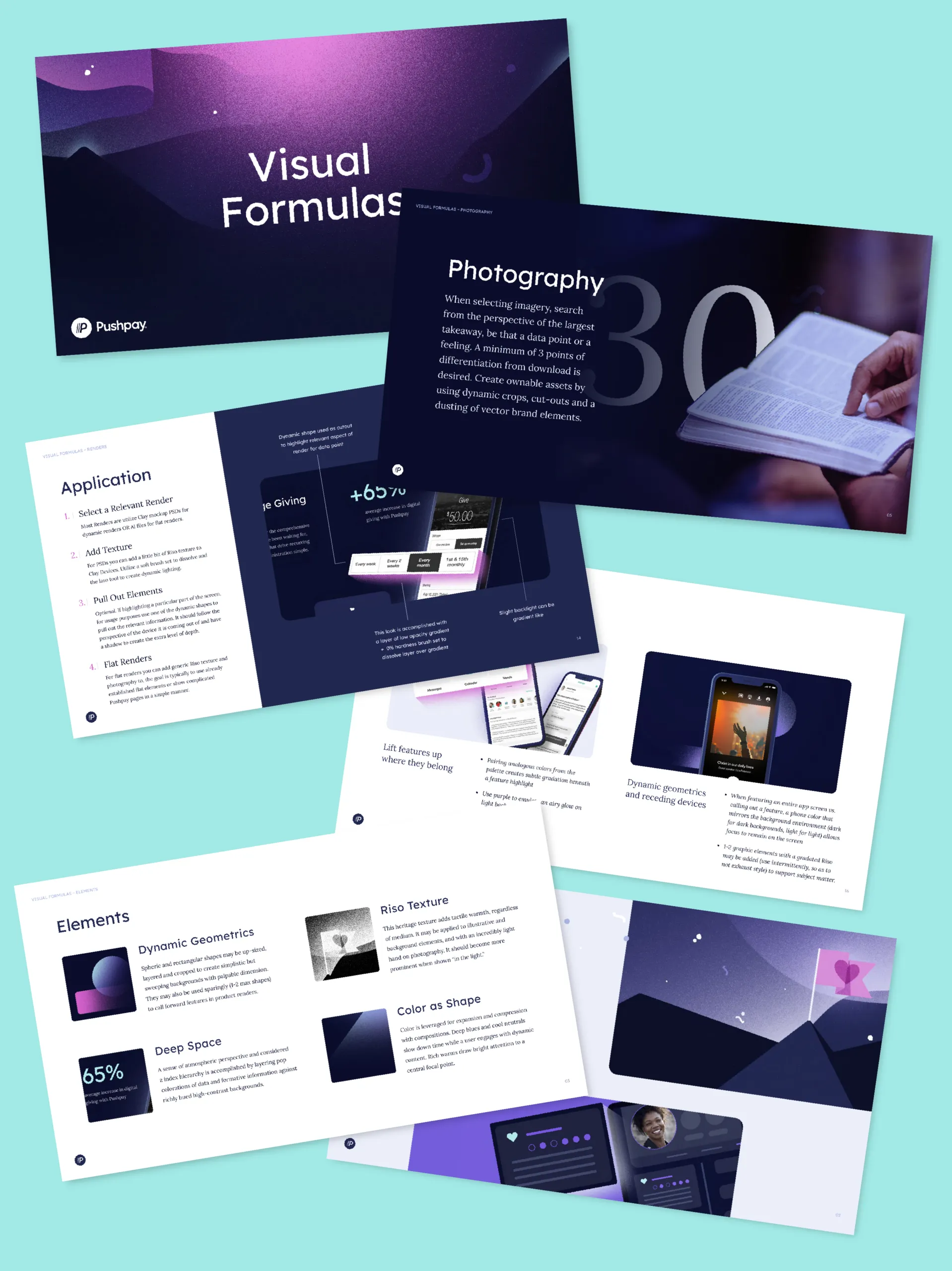
Central to that work was the Visual Formulas system — a practical, deeply considered guide that translated brand principles into repeatable creative patterns. It gave Pushpay something rare: a visual language that could be taught, reused, and evolved. As teams grew, new designers were hired, and campaigns expanded, the system held. The brand didn’t just scale — it stayed coherent.
rock paper saas
Earning trust when “paper” was the competition
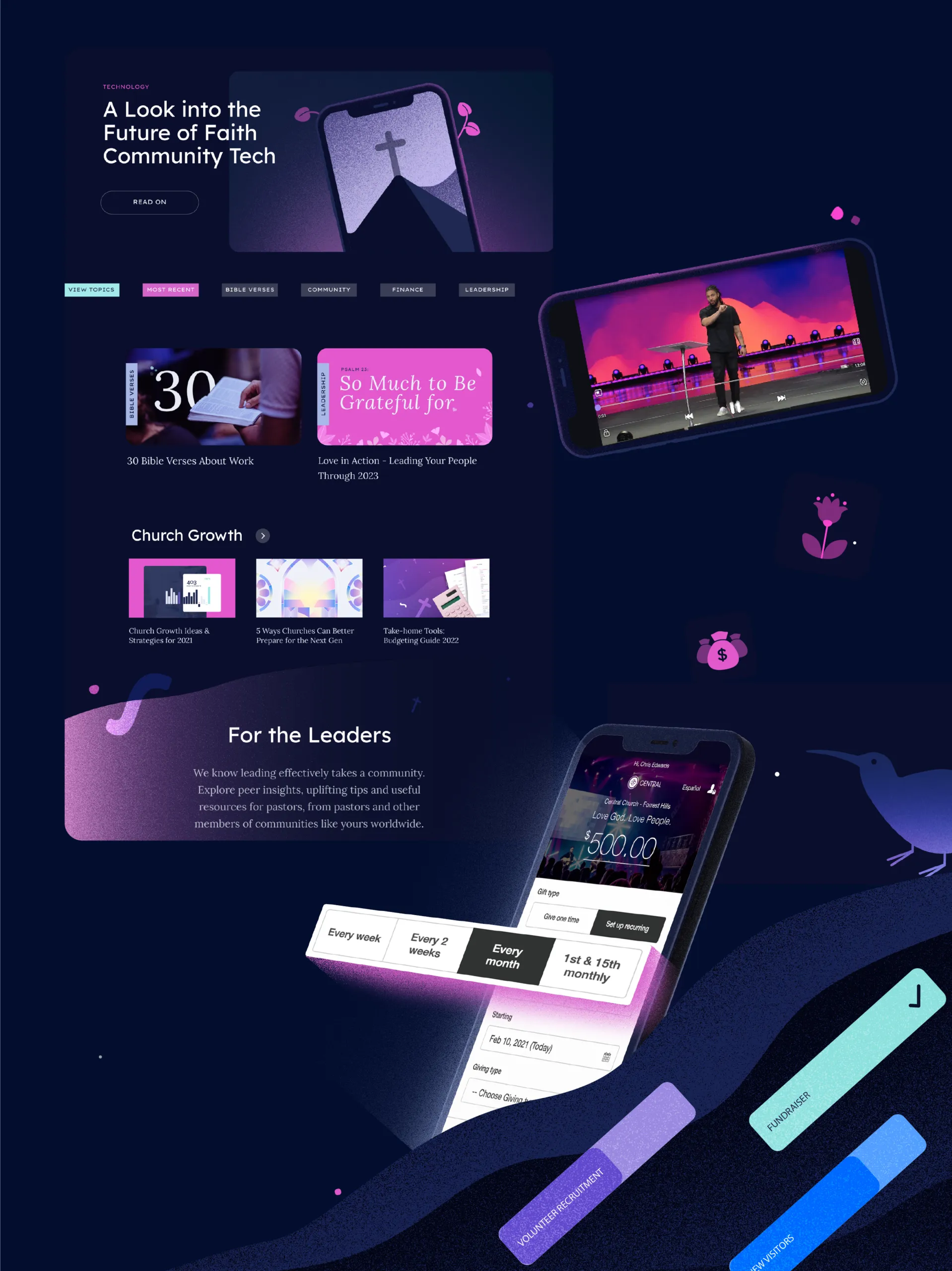
For many of Pushpay’s audiences, the real competitor wasn’t another platform. It was paper, habit, and hesitation. In some cases, the people they were speaking to had never fully digitized before. The work couldn’t just make the technology look good. It had to make it legible, calm, and worthy of trust.
We used visual clarity as a bridge. Through careful pacing, simplified moments of explanation, and a system of micrographics designed to translate complexity into something human-scaled, Pushpay’s tools became easier to understand and easier to believe in. These weren’t embellishments. They were teaching tools — small, intentional visuals that helped demystify the product and guide people forward without pressure. Trust wasn’t assumed. It was built, one clear moment at a time.
“THEY WEREN’T REJECTING THE TECHNOLOGY. THEY JUST DIDN’T SEE THEMSELVES IN IT — UNTIL NOW. WE’VE HAD A FEW PROSPECTS CRY DURING A DEMO OF OUR PRODUCT. THEY DIDN’T KNOW IT WAS AN OPTION FOR THEM.”
PUSHPAY POSITIONING & ALIGNMENT RESEARCH
What did MALI do for Pushpay?
We were brought in after Pushpay acquired Church Community Builder to solve what we called the merger mystery: how to unify two trusted platforms, two loyal user bases, and two distinct brand histories into one coherent brand without flattening what made each matter. The work spanned creative strategy, brand design, and website design and development, including a flexible brand system, a custom WordPress ecosystem, research-driven positioning, and the tools that let Pushpay expand confidently into new markets.
How do you unify two brands after a merger or acquisition?
Alignment before aesthetics. We started with people, not pixels, running deep workshops with founders, product, marketing, design, leadership, and board members across both organizations. The goal was not compromise but synthesis: finding the strongest elements of each brand and building a shared language to hold them together. That produced a unified narrative that respected each brand’s history while creating room to grow, so both audiences still felt seen rather than absorbed.
What is a brand system, and why does it matter for a growing company?
A brand system is the set of frameworks, patterns, and guidelines that let a brand stay coherent as it scales. For Pushpay, central to the work was our Visual Formulas system: a practical guide that translated brand principles into repeatable creative patterns that could be taught, reused, and evolved. As teams grew, new designers came on, and campaigns expanded, the system held. The brand did not just scale, it stayed consistent, which is exactly what a good system is for.
How do you help a company expand into a new market?
With research, empathy, and language that earns trust from the inside. One of the biggest expansions this work supported was Pushpay’s entry into the Catholic market, an audience with distinct structures, governance, and expectations. We conducted deep research into parish operations and cultural nuances, then produced usable guides that educated Pushpay’s own sales, marketing, leadership, and board on how to speak credibly and respectfully as insiders. The message landed, and what had felt misaligned became an authentic point of connection.
How do you build trust for a product when the competition is habit, not another brand?
By making the technology legible, calm, and worthy of trust. For many of Pushpay’s audiences, the real competitor was paper and hesitation, people who had never fully digitized. So we used visual clarity as a bridge: careful pacing, simplified moments of explanation, and a system of micrographics that translated complexity into something human-scaled. These were not embellishments, they were teaching tools that demystified the product and guided people forward without pressure. Trust was not assumed. It was built one clear moment at a time.
Do you work with mission-driven organizations and faith-based companies?
Yes, it is one of our core areas. Pushpay is one of 28+ mission-driven organizations we have partnered with, and this kind of work, where trust matters more than trend, is exactly where we do our best. Whether you are a faith-based platform, a nonprofit, or any purpose-led organization, we understand that the brand has to carry real credibility with the communities it serves, not just look good.
Can you do this kind of brand work for other SaaS or tech companies?
Absolutely. Pushpay reflects several of our core strengths: unifying brands after an acquisition, building flexible systems that scale, and making complex technology feel human and trustworthy. If your company is navigating a merger, outgrowing its brand, or trying to enter a market where credibility is everything, that is exactly the kind of challenge we are built to solve.
Mapping empathy to opportunity: throwing the door wide for a long-coveted market
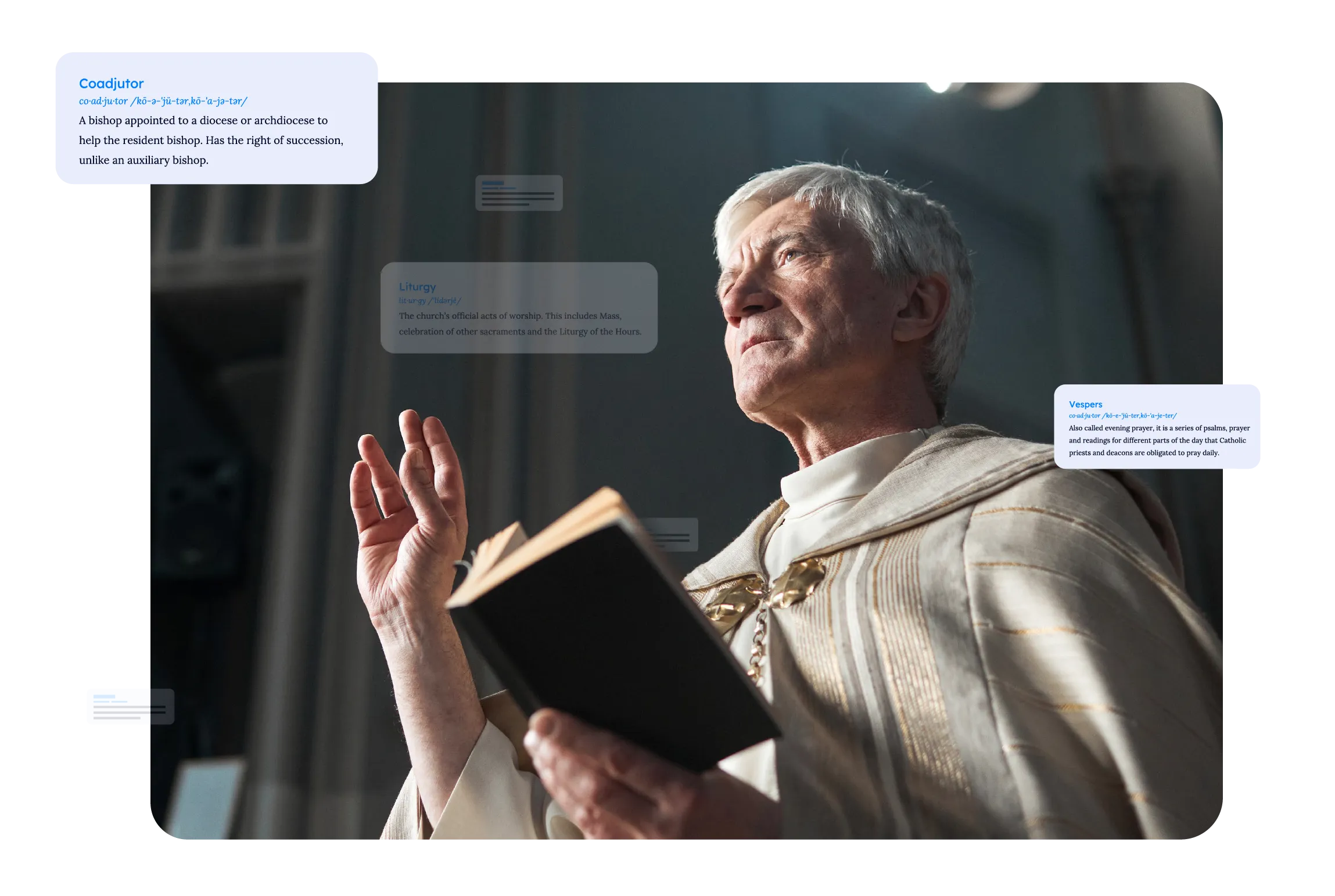
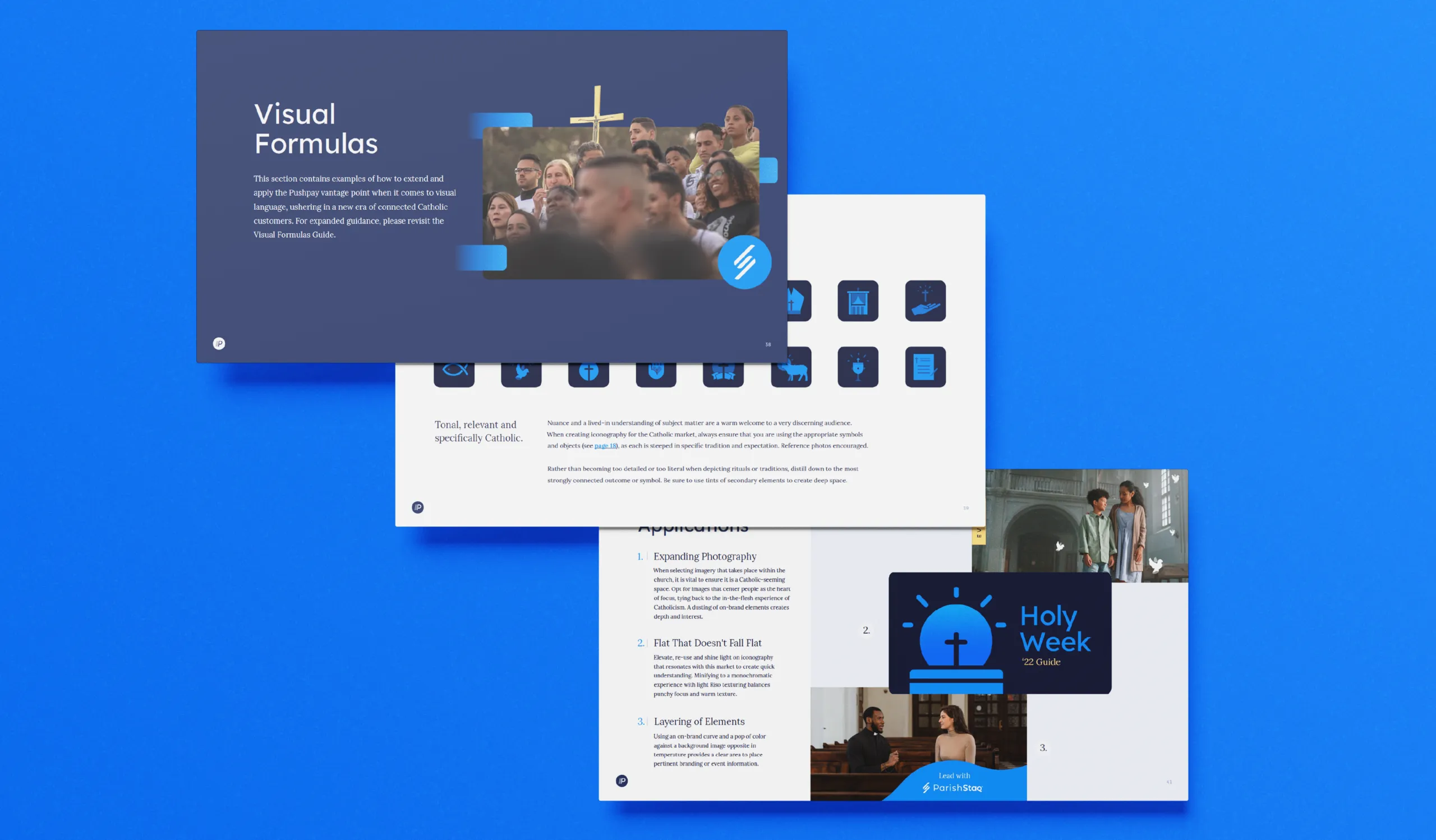
One of the most significant expansions supported by this work was Pushpay’s entry into the Catholic market — an audience with distinct structures, language, governance, and expectations. While Pushpay had long wanted to serve this community, internal messaging and assumptions were unintentionally eroding trust.
We conducted deep research into Catholic parish operations, decision-making models, and cultural nuances, producing usable guides that went far beyond surface insights. This work wasn’t just external — it educated internal teams, giving sales, marketing, leadership, and the board a shared understanding of how to speak credibly and respectfully as insiders.
A foundation built to keep growing
The impact of this work extended well beyond launch. Pushpay emerged with a cohesive voice that unified the organization post-acquisition while creating room to grow. The systems put in place are still in use today, allowing the site to evolve seamlessly as campaigns launch, teams expand, and new audiences come into view. What once felt complex now moves with clarity, making it easier for Pushpay to scale without losing trust or momentum.
Solving the merger mystery wasn’t about choosing one brand over another. It was about building something larger than either alone. Pushpay gained a shared language, flexible frameworks, and the confidence to expand into new markets while staying grounded in the communities they serve. For us, the honor was helping bring coherence to complexity — and giving a mission-driven organization the structure it needed to keep growing with intention.